 English
 русский

SEARCH
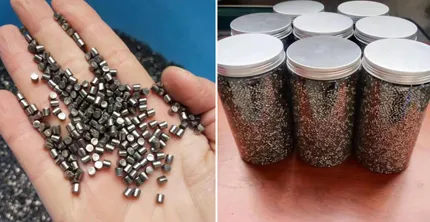
As Grade‑0 titanium sponge prices tumbled from 80 000 CNY/ton in 2022 down to 44 000 CNY/ton; as China’s titanium sponge capacity rocketed from 110 000 tons in 2017 to 375 700 tons in 2025; as Osaka Titanium Technologies of Japan launched a JPY 39‑billion capacity‑expansion project and Kazakhstan’s UKTMP rolled out a USD 520‑million investment plan — this is far more than a regular industrial‑cycle fluctuation. It represents a “capacity‑expansion tsunami” set to completely redraw the global titanium‑metal industrial map.
Over the next 24‑36 months, which players will be phased out and which will emerge victorious? How can procurement teams lock‑in costs? Titanium‑Home presents the analysis backed by hard data.
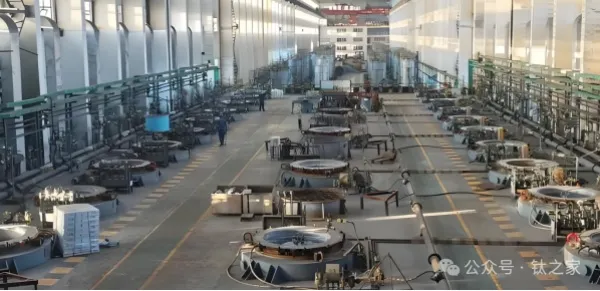
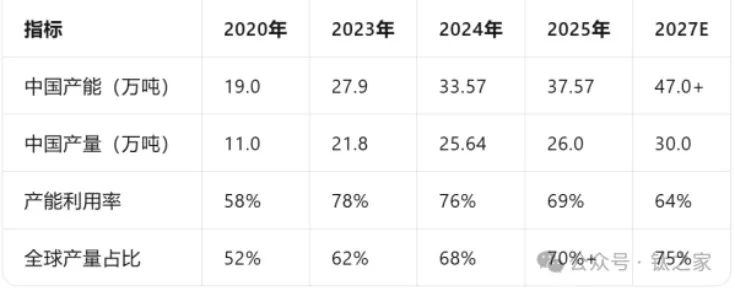
China’s titanium‑sponge industry has accomplished an epic leap over the past decade. Its output stood at merely 59 000 tons in 2015, rose to 256 400 tons in 2024, and climbed further to roughly 260 000 tons in 2025. Its global share soared from 40 % in 2014 to over 70 %.
Of greater significance is the pace of capacity expansion. China’s titanium‑sponge capacity hit 375 700 tons in 2025, representing an 11.92 % year‑on‑year increase. Planned total future capacity is projected to reach 607 000 tons. That means China’s planned capacity alone equals 1.3 times the current global total capacity of 470 000 tons.
China is not the only region ramping‑up production. Osaka Titanium Technologies of Japan increased its investment from JPY 33 billion to JPY 39 billion, aiming to lift annual capacity at its Amagasaki plant from 40 000 tons to 50 000 tons, with completion scheduled for early 2028. Toho Titanium added 3 000 tons of combined new capacity across its two plants, which went into operation in January 2026.
The expansion by Kazakhstan’s UKTMP carries particular strategic weight. Following Western supply‑chain sanctions against Russian titanium materials, UKTMP launched a USD 520‑million investment program running through 2033, targeting an 18‑20 % market share in global aerospace‑grade titanium sponge.
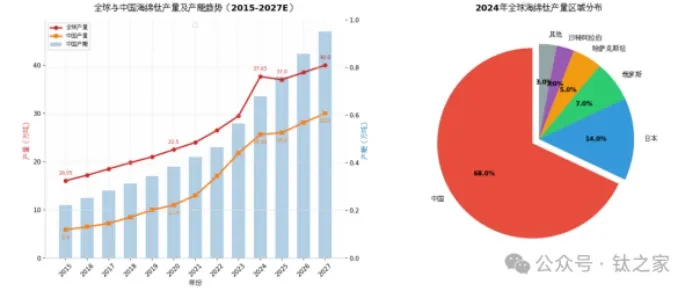
Global titanium‑sponge output reached 376 500 tons in 2024. Global capacity stood at 470 000 tons in 2025 with output at approximately 370 000 tons. Under current expansion timelines, global annual supply additions will stay within 15 000‑25 000 tons from 2026 to 2028, while annual demand growth amounts to only 10 000‑15 000 tons.
Conclusion: A structural surplus of 10 000‑30 000 tons per year will persist in the global titanium‑sponge market over the next three years, effectively eliminating upside potential for prices.
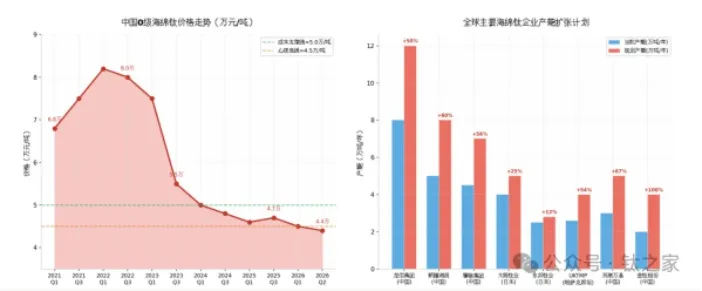
The price trend for China’s Grade‑0 titanium sponge resembles free‑fall:
Peak in 2022: approx. 82 000 CNY/ton
2023: sharp drop to 55 000 CNY/ton
2024: further decline to 48 000 CNY/ton
2025: full‑year average of 48 800 CNY/ton, hitting a low of 45 500 CNY/ton in November
Jan‑Apr 2026: average export price fell further to 46 061.69 CNY/ton, a year‑on‑year drop of 6.69 %
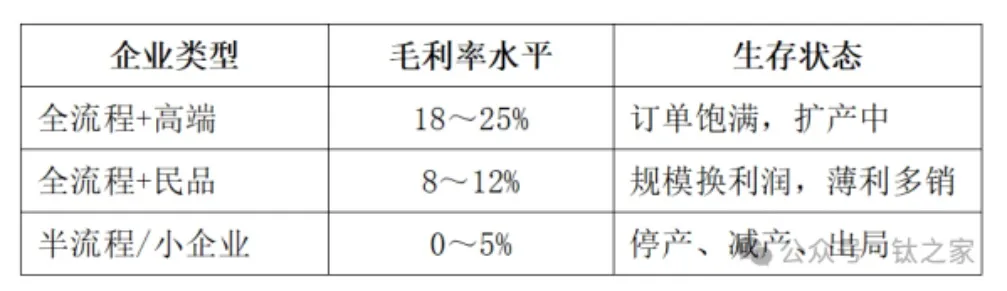
Falling prices have drastically divided corporate profitability.
Fundamental shifts have reshaped China’s titanium‑sponge trade landscape. China maintained a net‑import position from 2018 to 2022. Exports overtook imports starting in 2023, with exports hitting 6 000 tons in 2024 to achieve a trade surplus.
A deeper change lies in shifting pricing power. China’s average import price for titanium sponge in 2024 plunged 228 % compared with 47 900 CNY/ton in 2023, while export prices remained relatively resilient — evidence of rising competitiveness for Chinese products on international markets.
Western aerospace manufacturers including Boeing and Airbus are accelerating “de‑Russian‑sourcing” and, for high‑sensitive segments, “de‑Chinese‑sourcing”. Osaka Titanium’s capacity expansion is driven directly by surging post‑Russian‑source demand and Boeing’s commitment to diversifying its supplier base.
Kazakhstan’s UKTMP has emerged as a major beneficiary. Boasting AS9100 aerospace certification and non‑sanctioned‑country status, it accounted for 13 % of US titanium‑sponge imports in 2025.
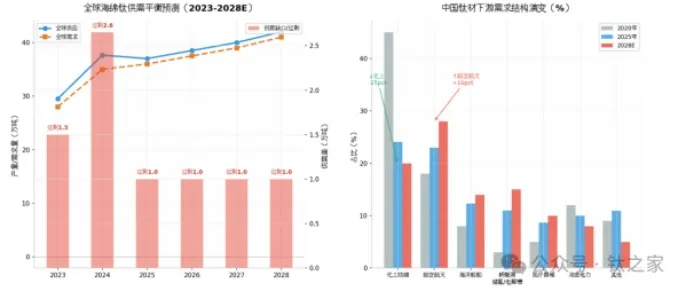
China’s titanium‑material consumption pattern is undergoing quiet transformation.
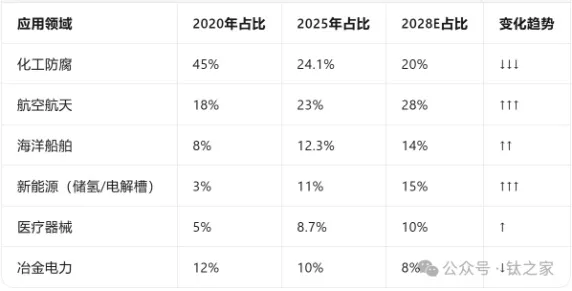
Key indicator: The aerospace‑and‑defense sector will surpass the chemical industry to become China’s largest end‑use market for titanium materials by 2028, rapidly narrowing the gap with European and US markets where aerospace accounts for over 50 % of titanium consumption.
Driver 1: Ramp‑up of domestically‑produced large aircraft.** The C919 has entered mass production and the C929 program has been launched. Each C919 consumes roughly 3.9 tons of titanium materials. At an annual delivery rate of 100 units, the C919 series alone generates nearly 400 tons of annual demand for aerospace‑grade titanium.
Driver 2: Boom in commercial space industry.** In the first half of 2026, China’s exports of high‑grade titanium materials to Europe and America rose 11.3 % year‑on‑year. Commercial space and satellite internet are fueling sharp growth in titanium‑alloy demand.
Driver 3: Hydrogen energy and energy‑storage sectors.** Titanium materials see fast‑growing adoption in electrolyzers and hydrogen‑storage tanks. The new‑energy sector represented 11 % of titanium consumption in 2025 and is projected to exceed 20 % by 2030.
Scale screening: A suggested minimum market‑access threshold of 30 000 tons per annum for titanium‑sponge production would eliminate players with capacities below this level.
Technology screening: Capacity utilization for aerospace‑grade titanium sponge (Grade‑0A, fine‑granularity) reaches 92 %, versus less than 50 % for civil‑construction‑grade material. Enterprises lacking aerospace certifications and unable to produce high‑end grades will bleed cash amid price competition.
Cost screening: Fully‑integrated chloride‑process producers hold a 3 000‑5 000 CNY/ton cost advantage over semi‑process facilities. At prices near 45 000 CNY/ton, semi‑process operators teeter on the brink of losses.
China’s titanium‑sponge CR4 (market share of top‑four producers) climbed from 57.15 % in 2020 to more than 70 % in 2024. CR6 is expected to surpass 85 % by 2028, moving the industry from oligopolistic competition toward tight oligopoly.
Principle 1: Pursue either high‑end positioning or scale; the middle ground carries the highest risk.
High‑end route: Focus on aerospace‑, medical‑ and electronic‑grade titanium sponge; obtain AS9100, NADCAP and other certifications to secure gross profit margins above 20 %.
Scale route: Emulate leading‑industry players, leveraging full‑integrated chloride‑process workflows and titanium‑ore resources to achieve industry‑minimum unit costs.
Principle 2: Capture upstream profits; vertical integration represents the ultimate competitive moat.
Some operators serve as valuable benchmarks. A full‑value‑chain model spanning titanium‑ore concentrate → titanium dioxide → titanium sponge delivers raw‑material costs 15‑20 % lower than those of buyers of external feedstock.
Principle 3: Green manufacturing is not merely a cost item, but a source of competitiveness.
Magnesium‑chlorine recycling and titanium‑scrap recovery rates above 90 % support national “dual‑carbon” goals while delivering tangible cost‑reduction benefits. Jintai Co., Ltd. has achieved substantial production‑cost savings by advancing low‑carbon green manufacturing.
Principle 4: Pursue high‑end global expansion instead of low‑price dumping.
The EU Carbon Border Adjustment Mechanism (CBAM) is in force, adding approximately EUR 150 per ton to titanium‑material shipments into Europe. Export competitiveness for mid‑to‑low‑grade titanium is weakening, yet high‑end titanium‑alloy exports to Europe and America grew 11.3 % year‑on‑year.
Principle 5: Seize windows of policy incentives.
Western‑region development policies: 15 % corporate‑income‑tax preference for deep‑titanium‑processing enterprises.
Major new‑material special programs: RMB 2.5‑5 billion funding for high‑end titanium‑alloy R&D.
Strategic stockpiling: Propose including titanium sponge within national strategic‑reserve catalogues.
For procurement:
Secure long‑term contracts: Current prices sit near historical lows (44 000‑47 000 CNY/ton). Consider 12‑24‑month long‑term agreements with leading producers to lock‑in costs.
Grade‑differentiated purchasing: Aerospace‑grade titanium sponge remains tight; secure supply 6 months in advance. Civil‑grade material may be procured on‑demand.
Monitor magnesium‑ingot pricing: Magnesium ingots account for more than 30 % of titanium‑sponge production costs; magnesium‑price swings directly affect titanium‑sponge prices.
For sales:
Shift toward high‑end customers: As chemical‑sector demand contracts, prioritize aerospace‑and‑defense, medical and new‑energy clients.
Refocus export destinations: High‑end European‑and‑American markets command large premiums (aerospace‑grade: 11‑14 USD/kg vs Chinese civil‑grade: 6‑7 USD/kg). Actively obtain international certifications.
Deliver value‑added solutions: Evolve from selling pure titanium‑sponge material to supplying material‑solution packages, including custom chemical composition and custom particle‑size specifications.
Conclusion: Who will prevail after industry reshuffling?
The global titanium‑sponge capacity‑expansion wave marks not an end‑point, but a necessary transition from unchecked rapid growth to mature market differentiation.
The industry roadmap for the next 2‑3 years is already defined:
2026‑2027: Mass exit of low‑end capacity, fierce price warfare and expanding industry‑wide losses.
2027‑2028: Gradual supply‑demand re‑balancing; prices return to a rational band of 55 000‑65 000 CNY/ton.
Post‑2028: CR6 exceeds 85 %, China dominates global pricing power, and self‑sufficiency for high‑end titanium materials surpasses 90 %.
For business leaders, this represents an endurance contest where “only the fittest survive”. For emerging entrepreneurs, it offers an optimal entry window into high‑end niche segments. For procurement and sales professionals, it constitutes a pivotal moment for restructuring supply chains and building long‑term partnerships.
Baoji Titanium Industry Research Institute exists to help new‑market entrants identify competitive pathways unavailable to competitors. We provide full‑chain professional services including project‑feasibility studies, comprehensive market analysis, talent training, government‑policy liaison, process‑technology development and equipment specification‑and‑procurement support.
Before you invest in the titanium industry, consult Baoji Titanium Industry Research Institute. We help you steer clear of red‑ocean competition and locate blue‑ocean opportunities.
Titanium‑Home will continue tracking industry developments. Our next feature will conduct an in‑depth analysis of certification barriers and domestic‑substitution opportunities for aerospace‑grade titanium sponge. Stay tuned.