 English
 русский

SEARCH
Aerospace manufacturing relies heavily on high-performance metal materials that balance weight, durability, and environmental adaptability, with aerospace titanium alloy and aerospace aluminum alloy being the two most widely used structural materials in the industry. Although both materials serve core lightweighting purposes for aircraft and aerospace equipment, their fundamental material properties and structural characteristics differ significantly, determining their unique application boundaries in aviation projects.
Aerospace aluminum alloy is a classic lightweight structural material featured by low density, excellent ductility, and easy formability. It boasts mature processing technology and stable comprehensive performance at room temperature, making it a cost-effective choice for general aerospace structural parts. In contrast, aerospace titanium alloy stands out for its ultra-high specific strength, outstanding structural stability, and superior anti-fatigue performance. It maintains stable physical and chemical properties in complex extreme environments, covering high-strength and high-load scenarios that aluminum alloys cannot support. As a professional aerospace material supplier, our titanium rod and titanium tube products are strictly manufactured in line with aerospace-grade standards to meet high-end structural assembly demands.
Aerospace aluminum alloy has an absolute advantage in ultra-lightweight performance. With a low overall density, it can effectively reduce the dead weight of aircraft and achieve significant fuel-saving effects. However, its tensile strength and structural rigidity are relatively limited, and it is prone to deformation and fatigue damage under long-term high-load operation.
Aerospace titanium alloy delivers far superior strength-to-weight performance. While maintaining a lightweight advantage close to aluminum alloy, its tensile strength and yield strength are greatly improved. This unique performance makes titanium alloy the preferred material for key load-bearing structures. Our high-precision titanium rod, as a typical titanium alloy finished product, is widely used in aerospace fasteners, connecting structural parts and key load-bearing components, providing stable structural support for aerospace equipment.
Aerospace equipment often operates in extreme environments of high temperature, high humidity, and strong corrosion, so the high-temperature resistance and corrosion resistance of materials directly determine the service life and operational safety of components. The performance gap between titanium alloy and aluminum alloy is extremely obvious in this dimension.
Aerospace aluminum alloy has a poor high-temperature tolerance, with a long-term stable working temperature not exceeding 200°C. When the temperature rises further, its strength and rigidity will drop sharply, and it is prone to thermal deformation and structural failure. In addition, aluminum alloy is susceptible to electrochemical corrosion in humid and marine aerospace environments, requiring additional anti-corrosion coating treatment.
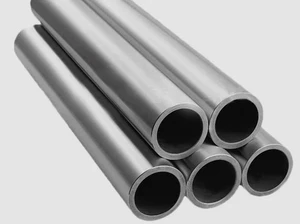
Aerospace titanium alloy has excellent high-temperature stability, which can maintain stable mechanical properties in the temperature range of 400°C to 550°C, perfectly adapting to the high-temperature working environment of aircraft engine peripheral components and high-speed flight structural parts. At the same time, it has natural excellent corrosion resistance, resisting oxidation, fuel corrosion and seawater erosion. Our aerospace-grade titanium tube is widely used in aircraft hydraulic pipelines and fuel delivery systems, relying on superior high-temperature and anti-corrosion performance to ensure the stable operation of internal fluid delivery systems.
Aerospace aluminum alloy has extremely good machinability, with low processing difficulty, high forming efficiency and low loss rate. Its raw material cost and processing cost are relatively low, and the industrial supply chain is extremely mature, supporting large-scale batch production with a short production cycle and flexible delivery cycle.
Aerospace titanium alloy has high material hardness and poor machinability, putting forward higher requirements for processing equipment and technology. Its raw material cost and processing cost are higher than aluminum alloy, and the production cycle of high-precision titanium alloy parts is relatively longer. However, its ultra-high service life and extreme environmental adaptability can greatly reduce the later maintenance and replacement cost of aerospace equipment, bringing higher long-term comprehensive benefits. We support customized processing of aerospace titanium rod and titanium tube of different specifications, and can balance high quality and stable delivery for high-end aerospace projects.
Aerospace aluminum alloy is mainly used for non-key and non-high-load structural components. Typical application scenarios include aircraft fuselage skin, interior decorative parts, ordinary support brackets, and low-load shell components. These scenarios prioritize lightweight and cost control, and the comprehensive performance of aluminum alloy can fully meet the operational requirements.
Aerospace titanium alloy is concentrated in core key components with high strength, high temperature resistance and high safety requirements. It is widely used in aircraft engine components, aerospace vehicle structural frames, high-load connecting parts, and extreme environment adaptive components. Among them, high-precision titanium rod is the core raw material for manufacturing aerospace fasteners and structural connecting parts, and titanium tube is an indispensable key material for aircraft hydraulic systems, fuel delivery pipelines and pneumatic systems, ensuring the safe and stable operation of core equipment.
First, judge according to the working temperature of the component. For parts working below 200°C with stable room temperature environment, aerospace aluminum alloy is the preferred choice; for long-term high-temperature working components above 300°C, aerospace titanium alloy must be used to avoid structural performance attenuation.
Finally, balance project budget and batch demand. For large-scale conventional structural parts with cost-sensitive requirements, aluminum alloy with mature supply and low cost is prioritized; for high-precision, high-reliability core components with high safety standards, titanium alloy is the exclusive reliable choice.
Performance & Parameter | Aerospace Titanium Alloy | Aerospace Aluminum Alloy |
|---|---|---|
Density | Medium (4.51 g/cm³) | Ultra-light (2.7 g/cm³) |
Maximum Working Temperature | 400–550°C | ≤200°C |
Specific Strength | Extremely high | Medium |
Corrosion Resistance | Excellent (oxidation & corrosion resistant) | General (needs anti-corrosion treatment) |
Machinability | Difficult, high processing requirements | Easy, high forming efficiency |
Comprehensive Cost | High | Low |
Core Application | High-temperature, high-load core components | Low-load lightweight structural parts |
Neither material is universally superior, as they apply to different aerospace structural scenarios. Aerospace aluminum alloy is better for low-load, room-temperature, cost-sensitive lightweight structures, while aerospace titanium alloy is the better choice for high-load, high-temperature, and high-corrosion working environments that require long-term structural stability and safety.
No. Aerospace aluminum alloy will experience severe strength attenuation and thermal deformation when working above 200°C, which cannot meet the safety standards of high-temperature aerospace components. Only aerospace titanium alloy with stable high-temperature performance can be used for engine peripheral parts and high-speed flight structural components.
Aerospace titanium alloy features ultra-high specific strength, excellent high-temperature resistance, superior corrosion and oxidation resistance, and outstanding anti-fatigue performance. It can maintain stable working performance in extreme aerospace environments, greatly extending the service life of key equipment components and improving overall operational safety.