 English
 русский

SEARCH
To choose reliable titanium target manufacturers for a PVD coating project, buyers should evaluate more than the quoted price and nominal titanium purity. A dependable manufacturer should be able to match the target material, purity, dimensions, surface condition, microstructure, inspection method, and packaging to the buyer’s coating equipment and film requirements. Before placing a production order, buyers should also verify material traceability, dimensional accuracy, customization capability, technical communication, and batch-to-batch consistency.
In a sputtering process, energetic ions bombard the target surface and release atoms that are subsequently deposited onto a substrate. Because the target is the source material for the deposited film, its condition can influence process stability and the characteristics of the resulting coating. Titanium targets are used in PVD applications involving electronics, medical devices, aerospace components, decorative coatings, and other functional surfaces.
However, a target described simply as “high-purity titanium” may not automatically be suitable for every project. A semiconductor-related coating, a decorative titanium nitride coating, and an experimental thin-film process may have very different requirements. The most effective supplier selection process therefore begins with the coating application, not with a generic product catalogue.
A reliable supplier cannot recommend the right titanium target without understanding how it will be used. Sending a complete technical request at the beginning reduces unnecessary quotations, specification errors, and repeated communication.
Start by explaining the purpose of the coating. Is the target intended for a metallic titanium film, a titanium nitride coating, a titanium oxide film, an adhesion layer, or another reactive sputtering process?
The answer affects the questions that should be discussed with the manufacturer. For example, a decorative coating project may focus on appearance, color consistency, production efficiency, and target life. A research project may place greater emphasis on purity, small-batch customization, and precise dimensions. A demanding functional coating may require closer control of impurities, surface quality, and production traceability.
Useful application information includes:
The substrate material being coated
The intended film composition
The required film thickness
The deposition environment
The expected coating performance
Whether the process uses reactive gases
Whether the project is for research, pilot production, or mass production
You do not need to reveal confidential process parameters. Nevertheless, providing enough context allows the supplier to identify potential specification conflicts before production begins.
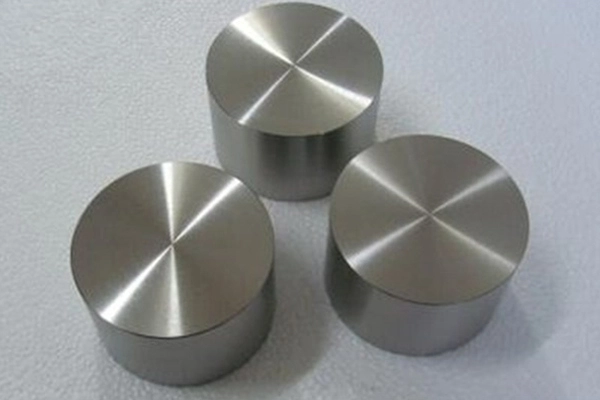
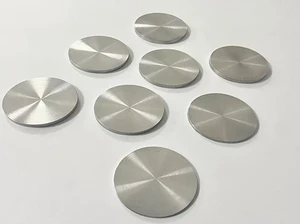
Titanium sputtering targets may be supplied in round, rectangular, planar, or other customized forms. Their dimensions must match the cathode, backing plate, mounting system, cooling arrangement, and usable erosion area of the coating equipment.
When requesting a quotation, provide a drawing whenever possible. The drawing should clearly state:
Diameter, length, and width
Target thickness
Dimensional tolerances
Hole positions
Edge profiles
Surface finish requirements
Flatness requirements
Backing plate information
Bonding requirements, when applicable
A manufacturer should not guess critical dimensions from a photograph or a general equipment model. Even small differences in mounting features or edge geometry can create installation problems.
For replacement targets, it is helpful to provide the previous target drawing, equipment manual, or detailed measurements. For a new coating line, the target manufacturer may also need to communicate with the equipment supplier or engineering team.
Purity is important, but it is only one part of target quality. Two targets carrying the same nominal purity may differ in impurity profile, density, grain structure, surface condition, and consistency.
Buyers often compare targets based on labels such as 99.95% or 99.99% titanium. A higher purity level may be appropriate when the coating process is sensitive to unwanted elements, but choosing the highest available purity is not always necessary.
The appropriate grade depends on the application, deposition process, film requirements, and budget. Before making a decision, ask the manufacturer for the chemical composition rather than relying only on a general purity statement.
Important questions include:
Which elements are included in the impurity analysis?
What testing method is used?
Is a batch-specific inspection report available?
Are oxygen, iron, nitrogen, carbon, and hydrogen controlled?
Does the quoted purity refer to the raw material or the finished target?
Can the supplier maintain the same specification for repeat orders?
Aulister’s current titanium target range includes GR1, GR2, 99.95%, and 99.99% options, giving buyers several starting points for matching material selection to application requirements.
The internal structure of a sputtering target deserves attention, especially in stable or demanding production processes. Manufacturing routes and heat treatment can affect grain size, grain orientation, and microstructural uniformity.
Research on metallic sputtering targets shows that grain size and orientation can affect target erosion behavior, discharge performance, sputtering rate, and film deposition behavior. The exact relationship varies by material and process, so buyers should avoid applying a single grain-size rule to every project.
Instead, ask whether the manufacturer controls:
Material density
Internal pores or inclusions
Grain-size distribution
Grain orientation
Microstructural uniformity
Heat-treatment conditions
For routine industrial coatings, a detailed microstructure report may not always be necessary. For sensitive processes, however, it can provide useful evidence that the target was manufactured consistently.
A finished target should arrive clean, properly machined, and protected against contamination or handling damage. Deep scratches, embedded particles, burrs, oxidation, oil residue, and poor edge finishing can create additional preparation work or interfere with process startup.
Precision machining, polishing, surface treatment, and appropriate packaging are used to control the condition of finished sputtering targets. Surface preparation can also affect burn-in behavior and particle performance during early deposition stages.
Ask the supplier how the target is cleaned, inspected, handled, and packed after machining. Photographs of the finished product before shipment can also be useful for custom orders.
A professional product page can show what a supplier offers, but it does not prove that every order will meet the required specification. Buyers should request evidence of how the material is processed and inspected.
The following table can be used when comparing potential titanium target manufacturers.
| Evaluation Item | Why It Matters | What to Ask the Manufacturer |
|---|---|---|
| Titanium grade and purity | Determines whether the material matches the coating requirements | Can you provide the complete chemical composition and a batch-specific report? |
| Material traceability | Helps connect the finished target to its raw material and production batch | Is each target marked with a heat number, batch number, or traceability code? |
| Density and internal quality | Reduces the risk of pores, inclusions, or inconsistent target behavior | How is density or internal quality inspected? |
| Grain structure | May influence erosion and deposition behavior in demanding processes | Can grain-size or microstructure data be provided when required? |
| Dimensional accuracy | Ensures correct installation and equipment compatibility | What tolerances can be maintained for thickness, diameter, flatness, and hole position? |
| Surface preparation | Affects cleanliness, installation, and process startup | What machining, polishing, cleaning, and final inspection steps are used? |
| Backing plate or bonding | Important for heat transfer and mechanical reliability | Which backing plate and bonding options are available? |
| Custom manufacturing | Allows the target to match non-standard equipment | Can you manufacture directly from a technical drawing? |
| Packaging | Protects the target against moisture, contamination, and transport damage | How is the target cleaned, sealed, separated, and packed? |
| Repeat-order consistency | Supports stable long-term production | How do you control specifications across different batches? |
| Technical support | Reduces mistakes during specification confirmation | Will an engineer review the drawing and application before production? |
| Lead time and capacity | Affects maintenance schedules and production continuity | What are the sample and batch-production lead times? |
This table is more useful than comparing price alone. A slightly lower quotation can become expensive when the target requires reworking, does not fit the cathode, arrives without inspection documentation, or performs inconsistently during production.
Inspection requirements should be agreed upon before the purchase order is placed. Depending on the project, relevant documents may include:
Chemical composition report
Material certificate
Dimensional inspection report
Surface inspection record
Density data
Microstructure report
Ultrasonic inspection report
Packaging photographs
Traceability information
Not every order requires every document. The key is to define what is necessary for your application and confirm whether it is included in the quoted price.
Manufacturers should also identify which requirements need third-party testing. This avoids confusion when a buyer expects an independent certificate but the quotation includes only an internal inspection report.
Technical capability is important, but a supplier must also manage drawings, revisions, deadlines, and repeat orders accurately.
Custom sputtering targets often require more than cutting a piece of titanium to size. The supplier may need to review tolerances, machining feasibility, flatness, edge details, backing plates, and bonding conditions.
A reliable manufacturer should identify unclear or conflicting requirements before production. Warning signs include immediately accepting an incomplete drawing, avoiding questions about the coating equipment, or providing a final quotation without confirming critical dimensions.
The supplier should clearly state:
Which dimensions are achievable
Which tolerances increase production difficulty
Whether machining allowance is required
Whether the target will be supplied as a standalone target or bonded assembly
Which surfaces are considered functional
How drawing revisions are controlled
For first-time custom orders, request a final drawing confirmation before manufacturing starts.
Good communication is part of product quality. The sales team does not need to answer every metallurgical question immediately, but it should be able to involve a technical specialist when necessary.
Pay attention to whether the supplier:
Responds directly to technical questions
Distinguishes confirmed data from estimates
Requests missing specifications
Explains available testing methods
Identifies production risks
Records drawing revisions accurately
Provides realistic lead times
Vague answers such as “no problem” or “standard quality” are not enough for a custom PVD component. Clear written confirmation protects both buyer and supplier.
A sample target may perform well, but a production buyer also needs stable repeat supply. Discuss how the manufacturer controls raw materials, production records, inspection criteria, and specification revisions over time.
For recurring orders, consider creating an approved specification that includes:
Material grade
Chemical limits
Target dimensions
Tolerances
Surface condition
Inspection requirements
Packaging method
Marking requirements
Approved drawing revision
This document can reduce variation and shorten the confirmation process for future orders.
Supplier selection does not need to become unnecessarily complicated. A staged qualification process can control risk while keeping the purchasing cycle efficient.
A useful titanium target RFQ should contain:
Titanium grade or required purity
Target shape and dimensions
Dimensional tolerances
Required quantity
Drawing or equipment information
Surface finish requirements
Backing plate and bonding requirements
Inspection and certification requirements
Packaging requirements
Application and deposition method
Required delivery date
Destination country or port
This information allows manufacturers to prepare comparable quotations. Without it, one supplier may quote a basic machined target while another includes bonding, inspection, special cleaning, and export packaging.
Review each quotation against the RFQ. Check whether the supplier has accepted every requirement or added exclusions.
A quotation should clearly identify:
Material specification
Final dimensions
Testing scope
Documentation
Production lead time
Packaging
Delivery terms
Quotation validity
Do not assume that an unmentioned requirement is included.
For a new supplier, custom geometry, or sensitive coating process, a sample order can be more valuable than immediately placing a large-volume order.
Inspect the first target for dimensions, appearance, documentation, packaging, and equipment fit. Then evaluate its behavior under the actual coating process.
If changes are required, record them in an updated drawing or approved specification. Informal comments in emails can easily be missed during repeat production.
Supplier qualification should continue after the first successful order. Track delivery accuracy, dimensional consistency, document completeness, packaging quality, technical response, and process performance.
This creates an objective basis for future purchasing decisions.
Common warning signs when evaluating titanium target manufacturers include:
Extremely low prices without a clear material specification
Refusal to provide composition or inspection information
Inconsistent answers about purity
Quotations based on incomplete drawings
No traceability between raw material and finished products
Unclear outsourcing arrangements
Poor packaging descriptions
Unrealistic production promises
Frequent changes to confirmed specifications
Limited technical support after payment
The right supplier is not necessarily the largest company or the one offering the highest purity. It is the manufacturer that can understand the application, confirm the specification, manufacture the target consistently, document the result, and support repeat procurement.
For standard or custom PVD requirements, buyers can review available options from titanium target manufacturers and submit the required grade, purity, dimensions, quantity, drawing, and application details for technical evaluation.
Look for material traceability, complete chemical composition data, accurate machining, controlled surface preparation, suitable inspection capabilities, secure packaging, and experience with custom drawings. The manufacturer should also ask about your coating application and equipment rather than quoting only from a target diameter and purity level.
Not necessarily. The suitable purity depends on the deposited film, acceptable impurity limits, process sensitivity, and project budget. A 99.99% target may be appropriate for more contamination-sensitive applications, while 99.95% may satisfy many other coating requirements. The decision should be based on the complete impurity profile, not only the total purity percentage.
Provide the titanium grade or purity, target shape, dimensions, tolerances, quantity, surface requirements, backing plate or bonding details, inspection documents, application, delivery destination, and required delivery date. A technical drawing is strongly recommended for custom targets.
Yes, titanium targets can be manufactured in different shapes, dimensions, thicknesses, and mounting configurations. However, customization feasibility depends on the target size, tolerances, raw material, machining requirements, and backing assembly. The manufacturer should review the equipment information and drawing before confirming production.
The microstructure of a metallic target can influence how its surface erodes and how it behaves during sputtering. Grain size, orientation, and uniformity may affect deposition performance, although the result also depends on the target material and coating conditions. Buyers with demanding processes should discuss microstructure requirements directly with the manufacturer.
A sample or first-article order is recommended when working with a new supplier, developing a new coating process, or purchasing a custom target. It allows the buyer to confirm dimensions, surface quality, equipment fit, documentation, packaging, and deposition performance before committing to a larger order.
Request batch-specific material documents, dimensional inspection results, manufacturing details, product photographs, packaging information, and references to similar projects where available. Begin with a controlled sample order and evaluate both the target itself and the supplier’s communication, delivery accuracy, and handling of technical requirements.