 English
 русский

SEARCH
Titanium Wire Coil: Titanium wire coils are the most common type of titanium wire, delivered continuously in a single coil. They are compactly packaged and easy to transport. Their biggest advantage is their high continuity, making them particularly suitable for uninterrupted feeding in automated equipment, eliminating the need for frequent reloading and increasing production efficiency. The length of the coil is controllable, with almost no excess cutting waste; only the required amount is taken out, making it ideal for long-term mass production. They are also flexible, easy to store, and space-saving, making them a common choice for most processing companies.
Straight Titanium Wire: Straight titanium wire is straightened and cut to length, delivered neatly in individual strands, ready for immediate use. Its highlights are high straightness and the elimination of secondary processing, making it suitable for manual assembly, precision assembly, and single-point processing. For processes that do not require continuous production and only require fixed-length parts, straight titanium wire is more convenient, eliminating the need for straightening and cutting; it's ready to use immediately.
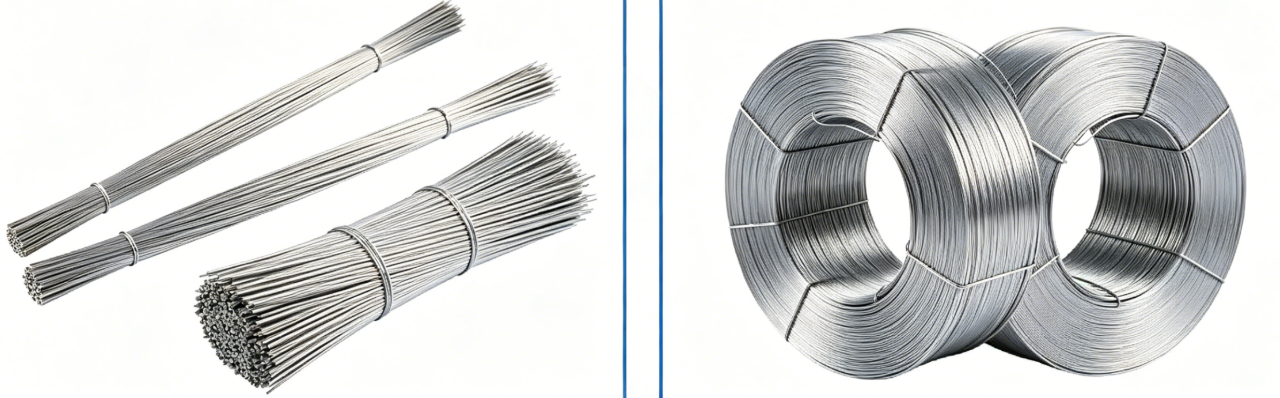
From appearance to usage, the differences between the two are quite obvious:
| Comparison Item | Titanium Wire Coil (Coiled) | Straight Titanium Wire |
|---|---|---|
| Form & Packaging | Compact roll; simpler packaging, lower shipping cost | Requires support, takes up more space; higher packaging & shipping cost |
| Processing Method | Suitable for automated production lines, continuous welding, spring winding, etc. | Mostly used for manual processing, precision assembly, small-batch / single-piece applications |
| Material Waste | Almost no cutting waste | Fixed-length cutting may produce small leftover pieces |
| Ease of Use | Requires feeding equipment; ideal for automated lines | Ready to use out of the box; no extra equipment; better for small workshops |
| Unit Price & Cost | No straightening/cutting step; relatively lower unit price | Extra straightening and cutting process; slightly higher unit price |
Many people worry that coiled titanium wire might not perform as well as straight wire. In fact, as long as the material grade is the same (e.g., both TI GR1 and GR5), coiled and straight titanium wires have identical mechanical strength, corrosion resistance, and biocompatibility. The main differences lie in surface condition and straightness: straight titanium wire undergoes specialized straightening, resulting in higher straightness precision; coiled titanium wire maintains good straightness even after uncoiling, meeting the requirements of most industrial, medical, and aerospace applications. Furthermore, both types of wire have the same requirements for surface cleanliness, oxidation-free, and oil-free surfaces, especially in the medical and aerospace fields where cleanliness standards are equally stringent.
Based on our years of experience serving clients, different processes actually have more suitable options: Automated production, spring manufacturing, continuous welding → titanium wire coil is preferred for high efficiency and low waste.
Medical implant components, precision instrument assembly, manual small-batch processing → Straight titanium wire is preferred for immediate application and assembly.
Aerospace structural components, heat exchanger components → Depends on the processing method; coiled wire is used for continuous forming, while straight wire is used for fixed-length components.
Jewelry processing, fine-diameter weaving → Coiled titanium wire offers greater flexibility and design freedom.
Laboratory research and development, small-batch prototyping → Straight titanium wire is more convenient and reduces pre-processing.
Don't get confused by complex parameters; choosing between coil and straight yarn is enough:
Is your equipment for automated continuous production or manual single-piece processing?
Do you need a fixed length? Can you accept cutting and straightening yourself?
What is the usage volume? Long-term batch use is more suitable for coil yarn, while small-batch trials are more suitable for straight yarn.
Are you sensitive to packaging space and transportation costs?
Related Products You May Like