 English
 русский
SEARCH
Titanium wire is a highly sought-after specialty metal in industries ranging from aerospace and medical to jewelry. But many people still have questions: What exactly is titanium wire? Is it stronger than steel wire? Where is it used? And what is titanium's "Achilles' heel"? This article answers the most common questions in plain language, giving you a complete picture of titanium wire.
Titanium wire is a filamentous metal product made from titanium metal through a series of precise processes: melting, rolling, drawing, annealing, and more. It mainly comes in two types: pure titanium wire and titanium alloy wire.
Pure titanium wire is flexible, skin-friendly, corrosion-resistant, and hypoallergenic – ideal for medical and precision applications. Titanium alloy wire retains the advantages of titanium while offering even higher strength, all while staying lightweight and durable. Titanium wire can be supplied in coils, straight lengths, flat profiles, or ultra-fine diameters, adapting to a wide range of industrial needs.
The answer is not absolute – it depends on the application.
For the same weight, titanium wire is significantly stronger than steel wire. Titanium has only about 60% the density of steel, giving it a major lightweight advantage. High-strength titanium alloy wire has a specific strength (strength-to-density ratio) far exceeding that of ordinary steel wire, making it ideal for aerospace and other weight-sensitive fields.
For the same diameter, however, high-carbon steel wire generally has higher absolute tensile strength than titanium wire.
In short: if you need a combination of light weight and high strength, choose titanium wire. If you only care about raw tensile hardness, steel wire has the edge.
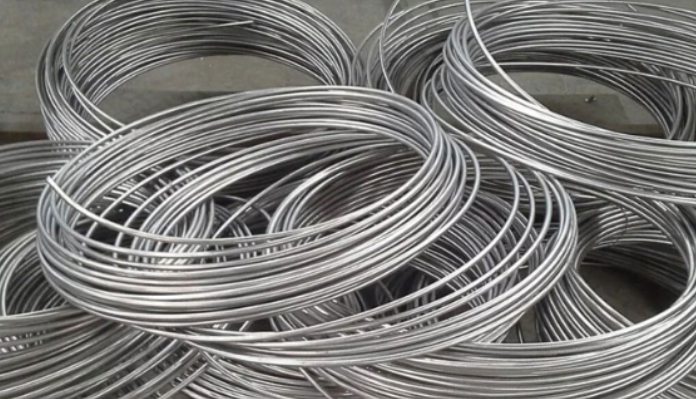
Thanks to its light weight, corrosion resistance, hypoallergenic properties, and high strength, titanium wire supports many essential but often unseen applications:
Aerospace – Used in heat exchangers and precision components, helping reduce aircraft weight while improving safety.
Medical & Healthcare – Gentle, hypoallergenic, and non-reactive. Commonly used in orthodontic wires and surgical instruments. Safe for long-term contact with the human body.
Chemical & Marine Engineering – Resists seawater, acids, and alkalis. Performs reliably in harsh environments without rusting or degrading.
Jewelry Design – Fine titanium wire is lightweight, non-allergenic, and comfortable. Used for ear wires, necklaces, and bracelets – beautiful and practical.
General Industry – Springs, electrodes, wire mesh, and custom-shaped parts all rely on titanium wire.
Titanium is among the most corrosion-resistant metals and is very hard to damage in daily use. But it does have a few weaknesses. Understanding them helps extend the life of titanium products:
Hydrogen embrittlement – Hydrogen absorption can make titanium brittle over time, reducing toughness and leading to cracking.
Strong acids at high temperatures – Concentrated hydrochloric acid or phosphoric acid at elevated temperatures can attack titanium's protective oxide layer.
Fluoride sensitivity – Fluoride compounds rapidly break down titanium's stable oxide film.
Reaction with oxygen and nitrogen at extreme temperatures – At very high temperatures, titanium reacts aggressively with oxygen and nitrogen, losing its stable properties.
Avoid prolonged contact with fluoride-containing substances (e.g., certain aggressive cleaning agents), which can damage titanium's protective surface film.
Titanium's stability decreases in high-temperature, strong-acid environments. Avoid such extreme conditions.
Prevent hydrogen embrittlement – during special welding or pickling processes, control the process carefully to maintain toughness and service life.
At extremely high temperatures, titanium reacts quickly with oxygen and nitrogen. For normal storage and use, just avoid extended exposure to extreme heat.
In short: normal air, water, sweat, and everyday environments are completely fine. As long as you avoid strong fluorides, high-temperature strong acids, and improper processing, titanium wire will remain stable and durable for a long time.
The price of titanium varies significantly depending on purity, form (wire, plate, ingot), and market conditions. Based on typical industrial-grade pure titanium pricing:
1 lb ≈ 0.4536 kg, so 20 lbs ≈ 9.07 kg
Industrial titanium currently costs around USD 15–30 per kg (price levels vary by market)
20 lbs of industrial titanium is roughly in the USD 150–300 range
For medical-grade or aerospace-grade high-purity titanium or titanium alloys, the price can be double or even several times higher. For real-time pricing, check current spot market quotes.
Medical and aerospace-grade titanium costs several times more than industrial titanium for several key reasons:
Extremely high purity requirements – Industrial titanium only needs to meet basic performance. Medical and aerospace grades must tightly control impurities – hydrogen, oxygen, nitrogen – and any excess is unacceptable. Raw materials are scarcer and more expensive.
More complex and stringent production processes – From melting and rolling to drawing, everything must be done in cleaner, more stable conditions. Additional annealing, finishing, and non-destructive testing steps increase production costs and reduce yield.
Stricter standards and costly certifications – Aerospace materials must meet aviation specifications. Medical titanium must be biocompatible, non-allergenic, and non-toxic. Extensive testing, certification, and batch traceability add significant cost.
Uncompromising performance stability – Aviation components affect flight safety. Implants affect human health. No performance variation is tolerated. Everything from raw materials to production must be top-tier – hence the much higher price.
Titanium wire drawing technology is now very mature. In industrial and commercial production, ultra-fine titanium wire can be as thin as 0.05 mm or even less.
This ultra-fine wire is used in precision electronics, minimally invasive medical devices, high-end jewelry weaving, and other advanced applications. The thinner the wire, the higher the manufacturing difficulty. Ultra-fine wire must maintain straightness, flexibility, and resistance to breakage – which is a core process advantage of premium titanium wire manufacturers.
Related Products You May Like